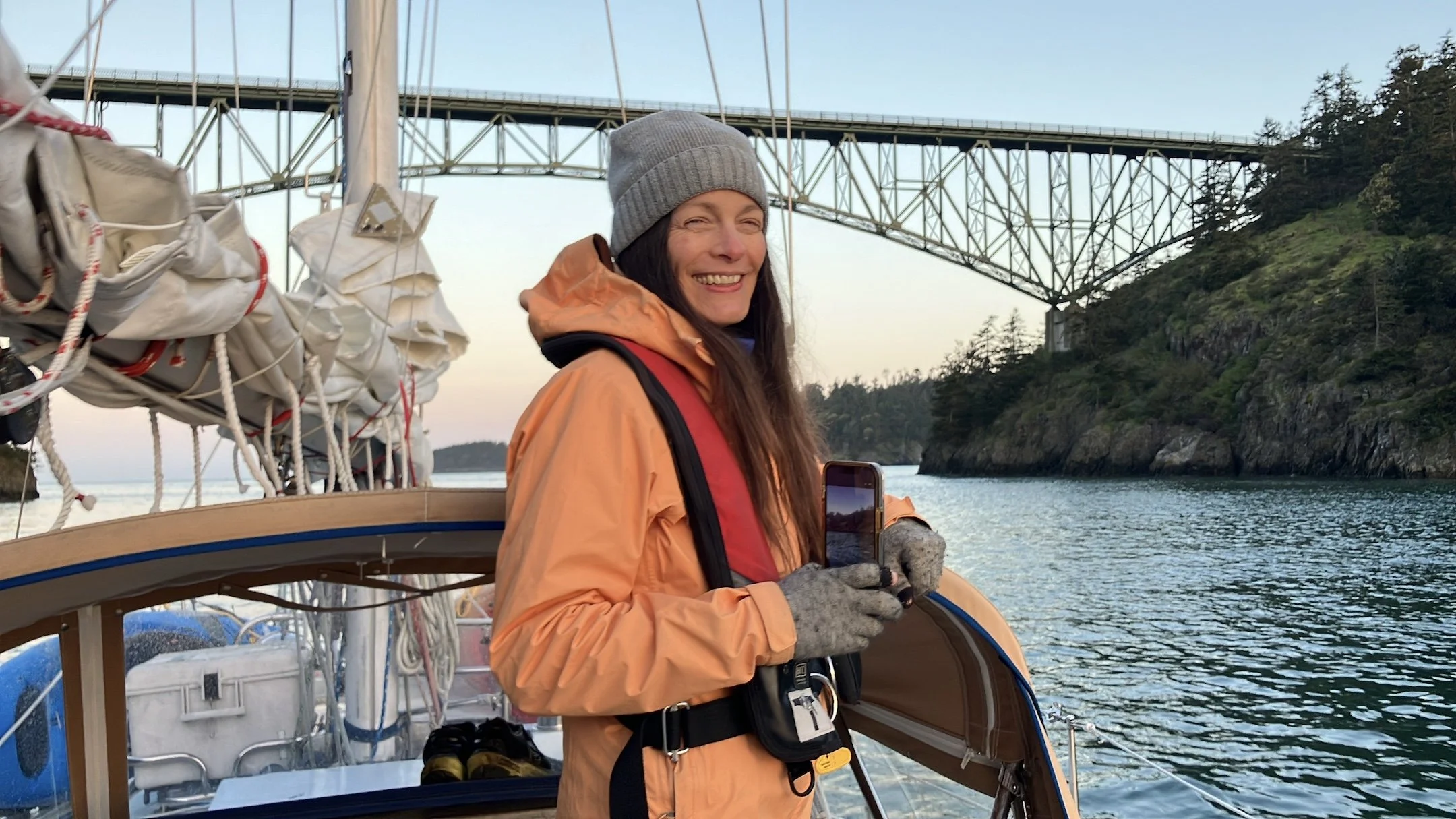
Last month I watched a panel discussion called Arctic Circle: Reflections on a Residency, about how a writing retreat can influence content produced by the writer. This virtual event was hosted by the Get Lit! Writers Conference taking place in Spokane, Washington. The two authors, Mita Mahato and Kathryn Nuernberger, participated in different years in the The Arctic Circle, a small vessel voyage residency program in the Norwegian Arctic of Svalbard that brings 30 artists and scientists together for a month of sea and ice in Arctic Norway. Both Mahato and Nuernberger had pitched projects peripherally related to the environment they were entering: Mahato writes about ecosystemic death and renewal and Nuernberger’s project was about the productive entanglement of organisms and the parallels to the human experience.
The timing of my viewing was helpful: I had just returned from my own modest writing retreat of five days on the small sailing vessel Cimaise. I say modest because my sole companion on the trip was my boyfriend and the captain of the boat, Seth; our sail was in our home waters of the North Salish Sea where we live, and we folded our dedicated working vacation into the lives we already live.
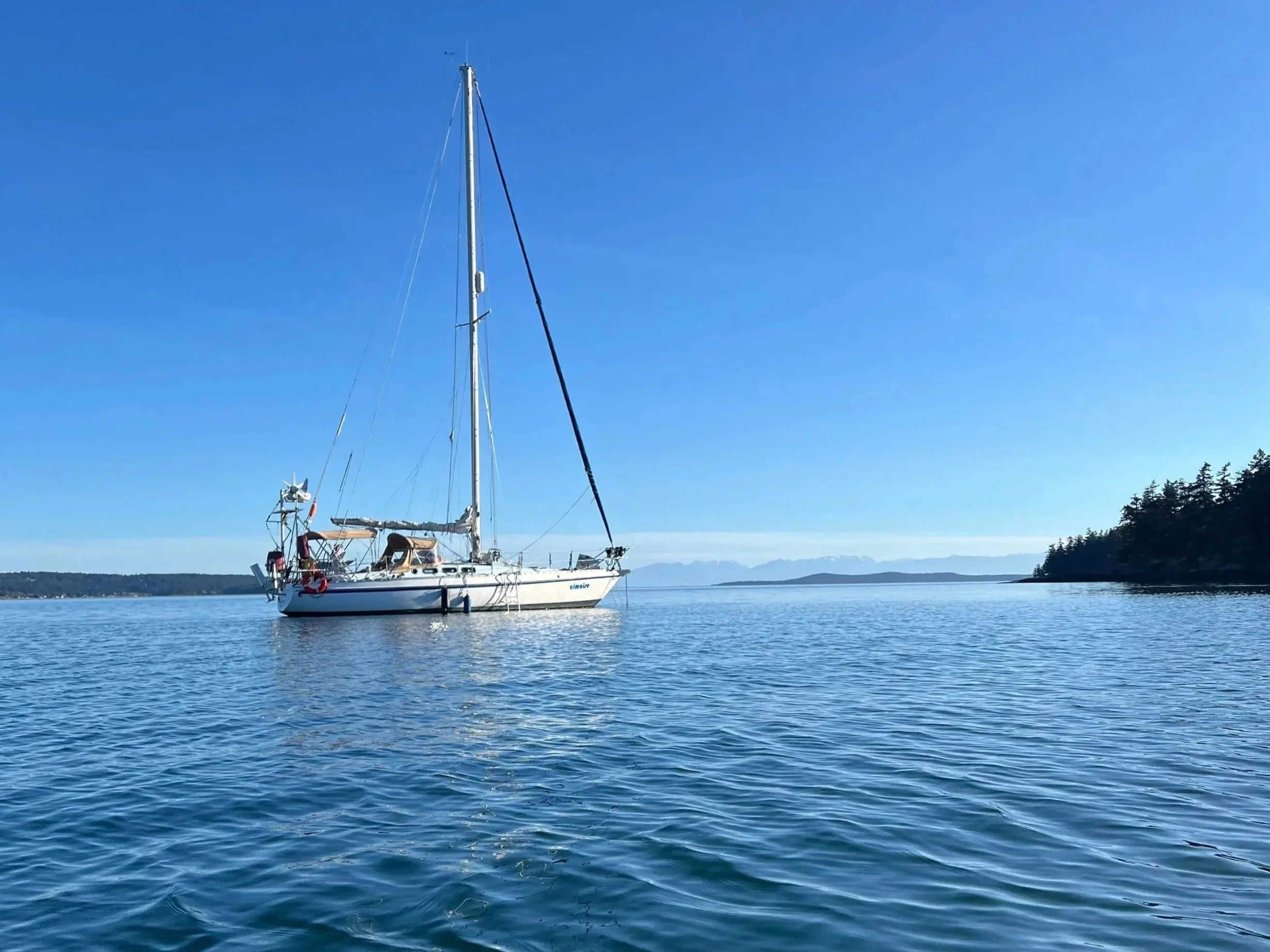
Cimaise anchored in Indian Cove off Shaw Island in the San Juan Islands, Washington State. The Olympic mountain range is in the distance. April 2026.
I had a break in parenting responsibility (my children were with their dad during the week of their spring break) and a project to finish. Seth is a live-aboard on his boat and our vacation cabin at sea is his home. We jumped at the option to get out on the water before boating season made the Salish Sea a boat highway, and while the early April weather promised a dry warming trend.
While my own project did not have a peripheral relation to my chosen nautical retreat environment, I knew instinctively that a change of scene —-a jolt from my usual writing spot of the couch at my house—would result in something valuable for the project I needed to complete. But it would take listening to that Arctic Circle panel discussion to process exactly what influenced my work, and how, in the end.
Like Mahato and Nuernberger, my home for the duration was a small vessel, the 37-foot sailboat, Cimaise. Though the research vessel they boarded was bigger and specialized for the Arctic, they too described their accommodations as compact with little privacy, and requiring a certain finesse and constitution for maneuvering in and out of cabins, into smaller boats (in our case, kayaks) to get to shore, and for tolerating the swells of some days passage during the trip.
And like the Arctic Circle experience for Mahato and Nuernberger, birds played a huge role in my nautical retreat.
Mahato observed purple sandpipers along the beach one day, and their behaviors resulted in a chapter of her book, Arctic Play. “I spent hours, sitting on the shore, watching them walk back and forth…without expectation of having to gain control of what I was seeing in words,” she said.
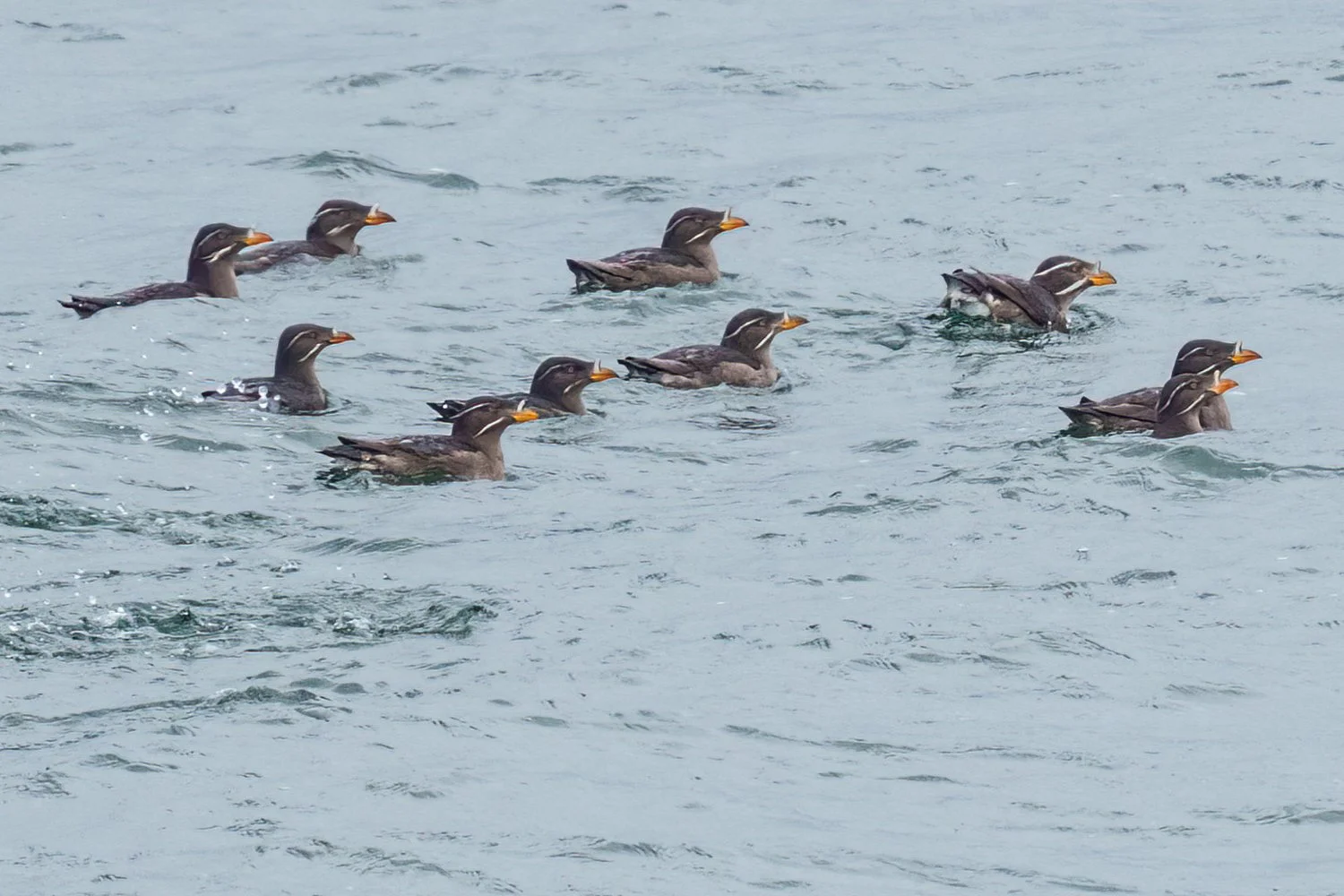
A raft of Rhinoceros Auklets. These dapper birds were by far the most abundant species on this boat trip. Photo by Sharon Wada.
Yes. Exactly that.
I write about birding culture—the people side of observing birds—and all we do to incorporate birding into our lived lives. The birds themselves elude my analysis and subject focus for the stories I write. When observing birds myself, I suspend expectations for control of anything I am seeing or hearing. The birds simply are. What humans do in response to observing birds is something I can put into words more readily.
When I wasn’t working below deck on the presentation, I was birding. How could I not with April’s unveiling of everyone’s breeding plumage? Bundled up in my own version of down (two layers of socks and gloves to protect against the cold air on the water), I watched rafts of Rhinoceros Auklets, by far the most numerous bird on this trip. Pelagic and Double-crested cormerants, Common murres, Bonaparte’s gulls, and Pigeon guillemots added to the sightings further out. Closer to shore were the Harlequin ducks, Buffleheads, Common loon, and Horned grebes.
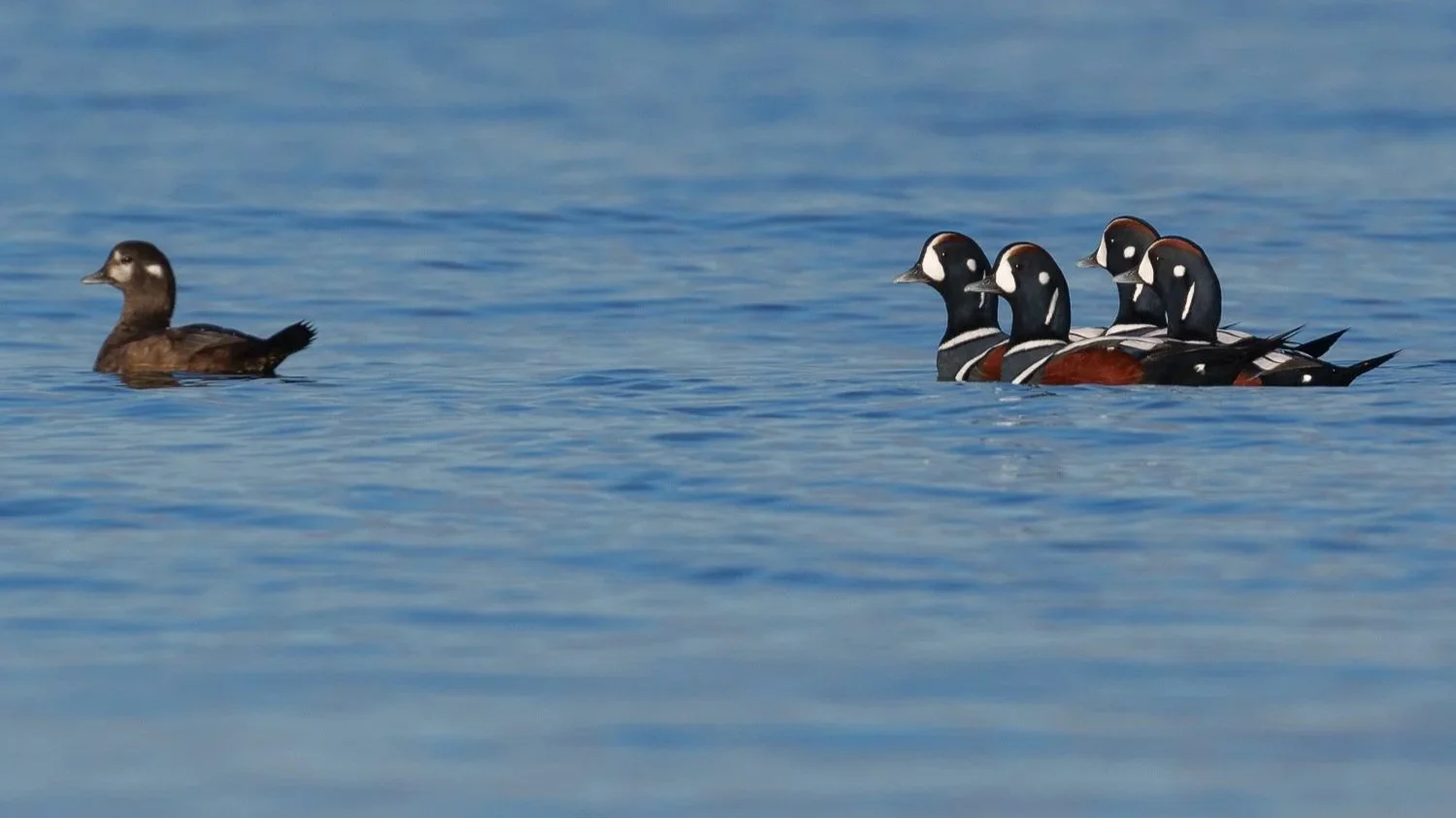
A quintet of Harlequin ducks. Photo: Sharon Wada.
Along the shoreline of San Juan Island on Griffin Bay I observed Black-bellied plovers, and Dunlin, shorebirds like those Mahato saw in the Norwegian Arctic. I too, watched all these birds without expectation. No expectation for numbers or variety or behavior or for our proximity to them, or for capturing an image of them.
I have Sharon Wada and Caroline Lichtenberger to thank for the images in this story. I am grateful to the talented people who make documentation a part of their birding practice. The rest of us benefit in the outcome of their efforts in capturing evocative moments of bird life. Wada and Lichtenberger took these photos in the same areas of the Salish Sea as my trip.
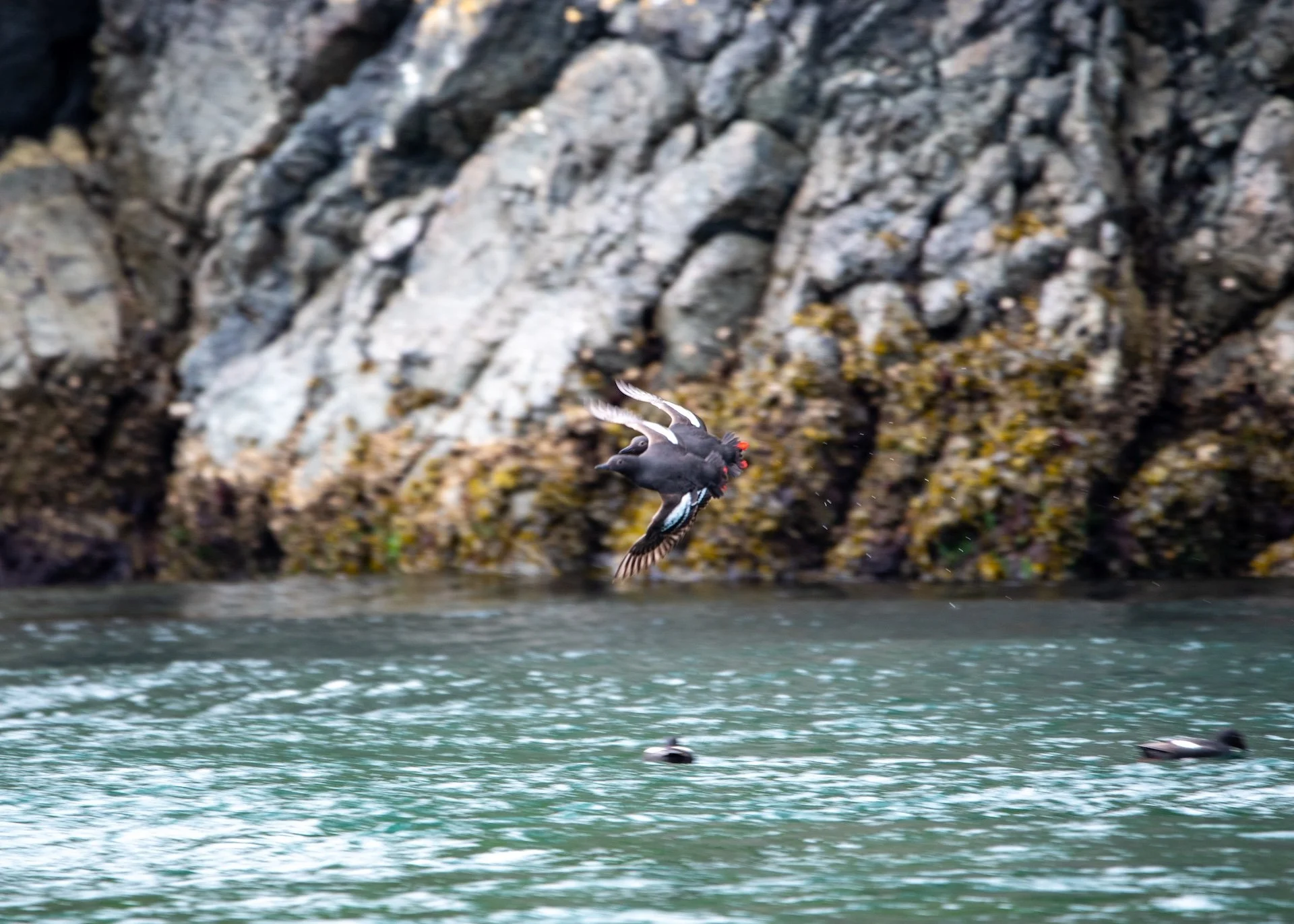
Pigeon Guillemots. Photo by Caroline Lichtenberger
So how did the setting of the workspace—the “retreat”—influence the project I worked on? Without anticipating it, I had chosen an unusual retreat model, as described by Mahato of the Arctic Circle retreat: “You’re on a cruise. The scenery is changing all the time, and it’s worth seeing. It’s not like other retreats where there’s all this quiet desk time.” Mahato processed many of her observations after the trip was over.
Meanwhile Nuernberger, stayed back in the afternoons on the ship instead of joining the others, in order to have space to take notes on what she was seeing. Like Nuernberger, I split my day into halves: one half work the other half cruising to the next anchor and going ashore to stretch our legs. This was the arrangement Seth and I had made in advance to assure the dedicated work time for both of us (he had his own project to complete).
The dedicated four-ish hours of writing per day compelled me to be efficient. And the remoteness of our chosen anchor sites meant there was little distraction ashore other than a long walk and the aforementioned birding. I also trusted the space of the boat, having the precedent of many hours on it already leading up to this particular trip: the space was known to me yet could still be novel as a setting for the purpose of this retreat. I also trusted my companion, and his skill as our captain and my host.
Mahato and Nuernberger brought up the importance of trust, too, both trust in self and others. They discussed the surrender of control during a retreat, the anticipation for letting go of expectation, despite the purpose of the experience. Concurrent to this, both women identified safety concerns of being on a boat, and quickly aligned themselves with fellow participants who they surmised would make better companions in an emergency over others. The bonding the participants experienced was in the adventuring, the rustic living on the boat, the bracing against the elements of the Arctic: “A retreat at sea is not a place to practice a trust fall!” Nuernberger said. None of us would recommend a retreat on a boat if this is a space you know you will dread.
In the end, I completed the baseline for the presentation and populated it with most of the needed visuals. While working on it I engaged with other creative ideas and took notes to pick those up after my dedicated time for this project. There were moments I didn’t follow my rule and consciously put the project aside to riff on the other ideas. I allowed myself to do this, trusting I would return to the project with new energy.
I also birded every day of the trip. Birding is many things to me: a necessity, a luxury, something I do in deliberately in solitude or purposefully in the company of others. And birding is also a form of visibility, of occupying space in a community of humans who care about nature. Whether I document what I see or not (some of those days I eBirded), the act of observing birds honors the birds and their place in the world. If someone sees me birding, I am representing the practice as an ambassador, or further normalizing it for those who know I do it already: Seth is case in point; he is enthusiastically bird-curious and will share my birding interest with others as a form of introduction.
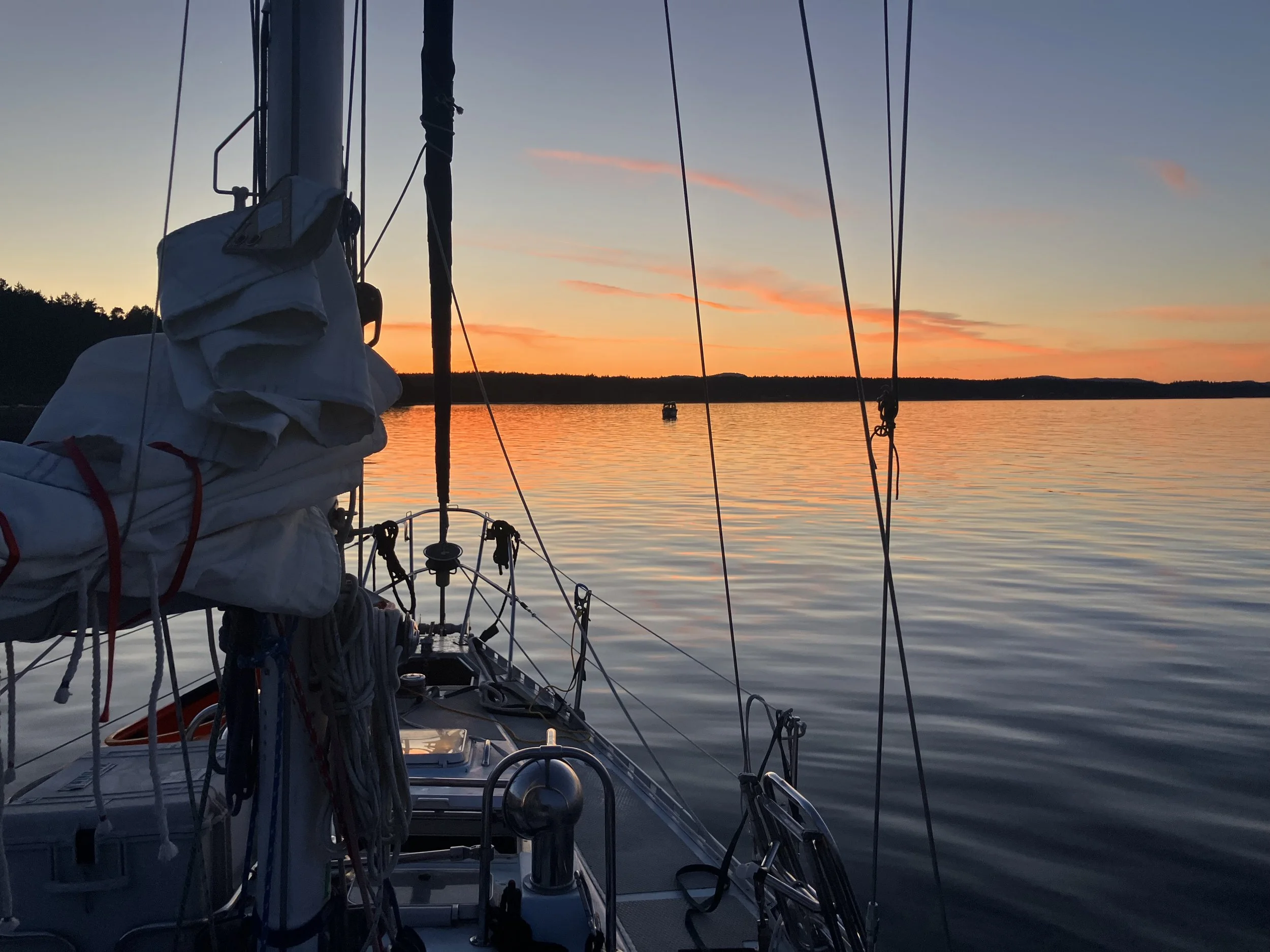
Sunset in Griffin Bay off San Juan Island, Washington. April 2026.
Speaking of sharing, if you like this post, please let me know below! Or forward it to a friend who might also enjoy it! If my content resonates for you, it may appeal to your friends, too. Let them know what kind of friendly birding stories live at my site for their reading pleasure.
I am challenging myself to a list-building effort for the month of May, and one way to build an audience is to ask my existing one to share my words with their friends. Thank you for considering!