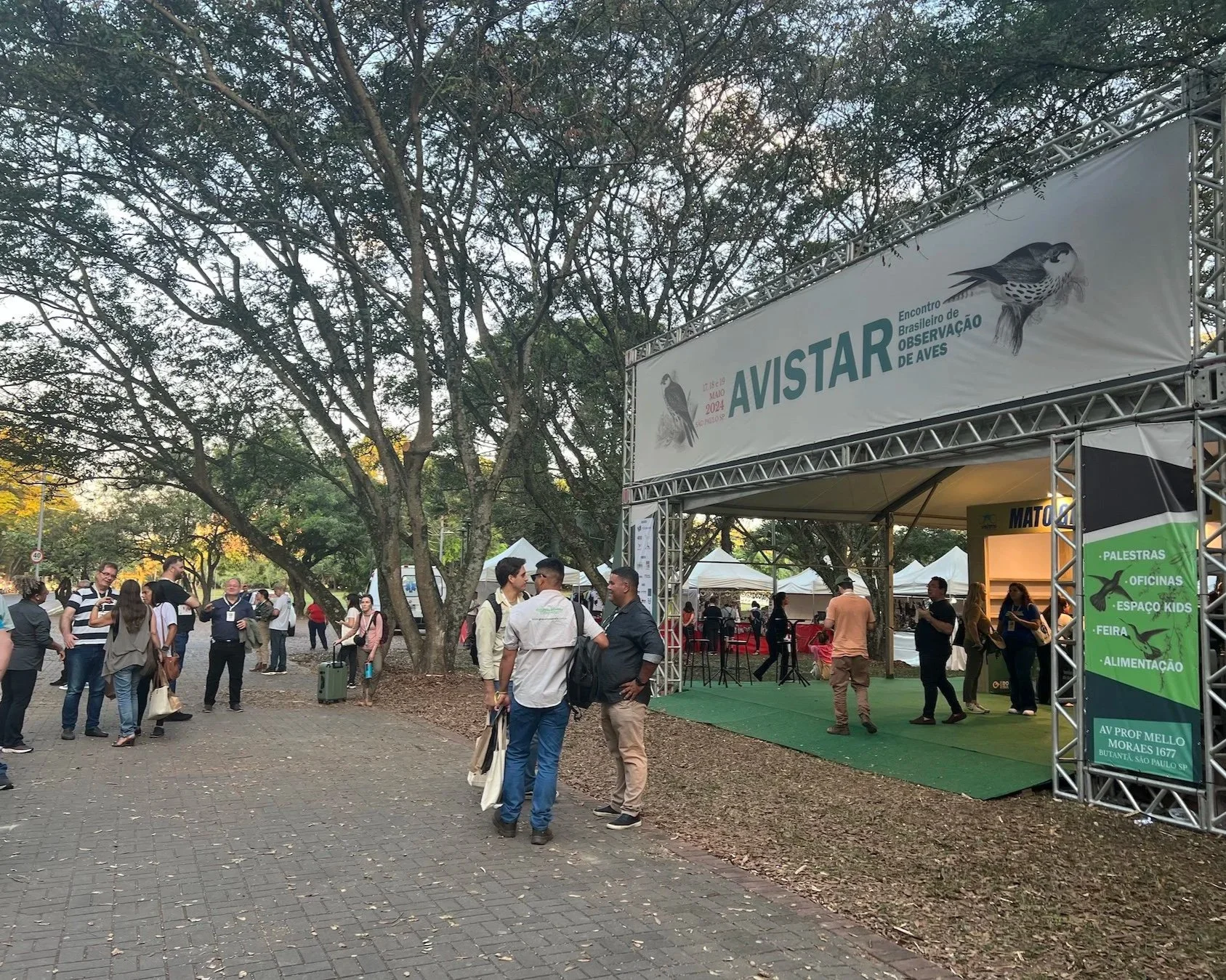
Birding festivals: There sure seem to be a lot of them (just check out this list at Cornell’s All About Birds of festivals around the world). Are they worth attending? Yes!
I recently attended the Puget Sound Bird Fest, hosted by Pilchuck Audubon, in Edmonds, Washington. This was my third festival attendance in 2026—one every other month so far—and had I looked closely at that calendar at Cornell, I would see there are multiple festivals every month of the year across North America, many overlapping. Birders have a lot to choose from if festivals are your jam.
Bird/Birding Festival/Fair: The basics
Birding festivals (or fairs) in the US are hosted by Audubon chapters, Bird Alliance chapters, city and state parks, bird observatories, town chambers of commerce, and other agencies and non-profits wanting to promote birding and bird conservation in their respective communities.
Outside the US they may be run by country tourism agencies partnering with local conservation organizations or ecotourism companies or by a country national conservation organization directly. Profits from festivals benefit a variety of bird conservation and community efforts: funds assist an organization itself; funds fuel a specific campaign based on that year’s identified need; ancillary money spent in the community justify local bird conservation efforts.
For a civilian (recreational) birder, they are a novelty draw over a weekend or multiple days to gather with others to observe a particular bird or migration season, participate in guided bird outings, listen to speakers, peruse information at bird and conservation organization tables, buy birding swag from vendors, and meet other birding enthusiasts.
For the professional birder a festival is also akin to attending a conference: intentional networking, and potentially participating as a paid contributor (often as a speaker or a guide, or both).
I attend bird festivals as both civilian and professional these days (read my account of attending The Biggest Week in American Birding from those lenses). I hope my observations from both perspectives inform and entertain you.
As a Civilian Birder: What I observe
What to expect from a bird festival? That depends on what you might be looking for as an individual birder: Bird festivals are varied in location, size, scope, intent, audience demographic, regional culture, affordability, ease of access, and what birds you might see.
Some bird festivals have a decidedly ornithological, scientific angle and others are more casual, social and targeted to beginner birders. Many festivals try to cover a range of entry points for bird enthusiasts whatever your level.
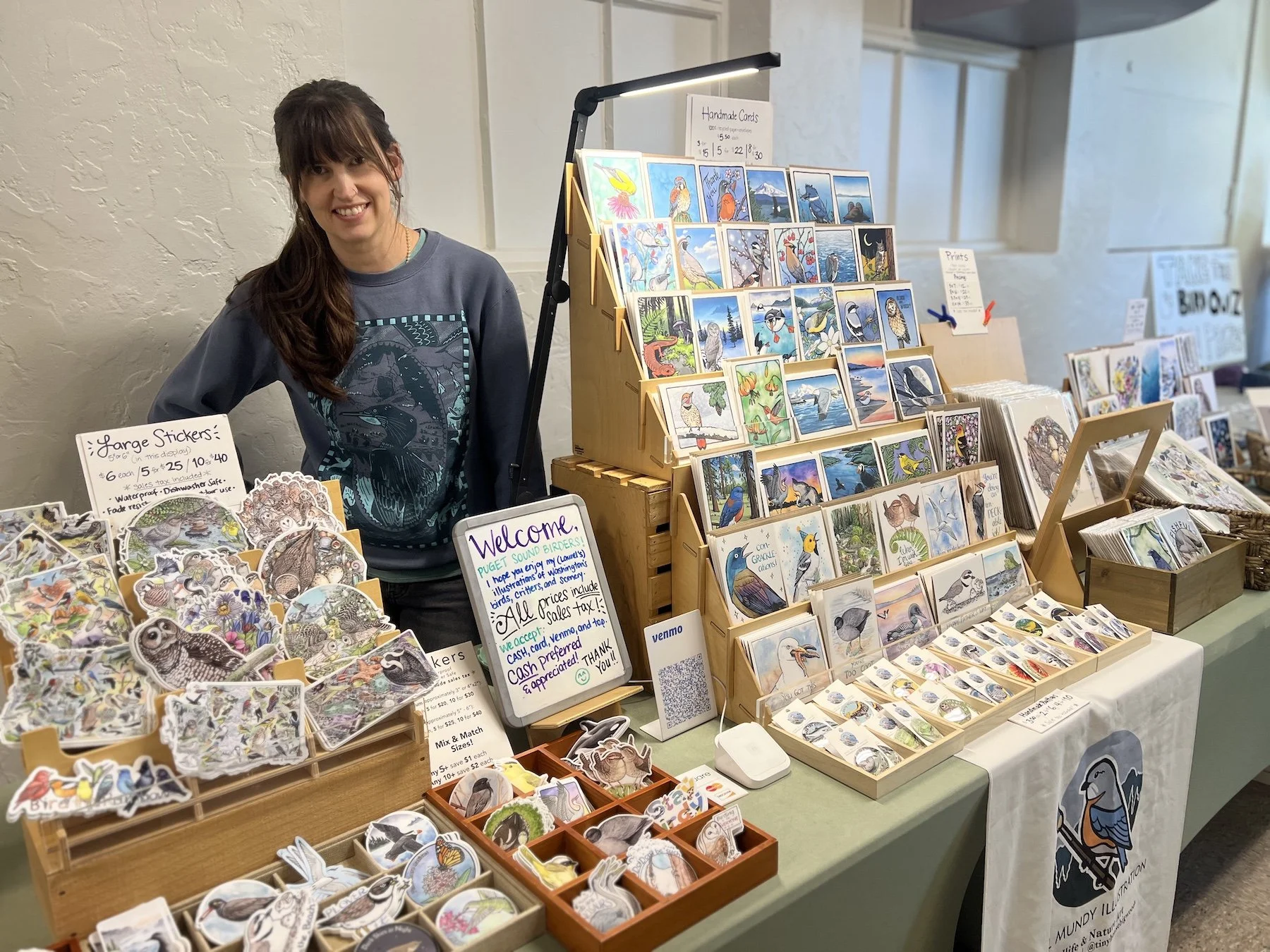
Laurel Mundy of Laurel Mundy Illustration, beloved designer of cards and stickers used throughout the birding, hiking, and other outdoor recreation scenes. Puget Sound Bird Fest, Edmonds, WA. June 2026.
Bird festivals everywhere generally share some basic components like guided trips, speakers, and vendors, but one festival might fan out from a high school gym with school bus rides into fields to see Sandhill Cranes while another might hold its events at a lakeside convention center and feature name brand speakers with an additional fee to attend the talk. Some festivals are entirely free for attendees and others have fees for participation from basic registration to additional cost for outings and special events.
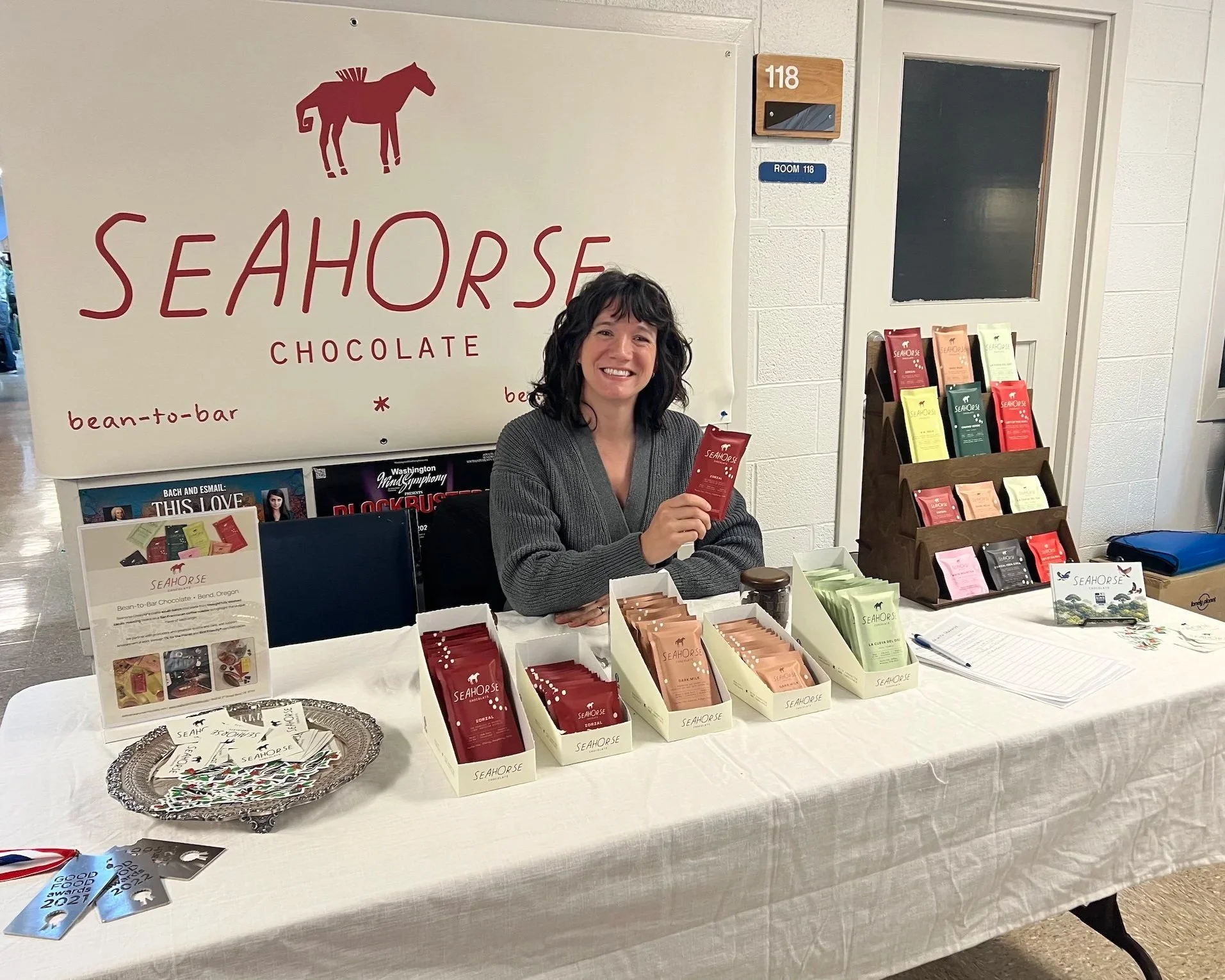
Emily Pappo, co-owner of Smithsonian Bird Friendly certified Seahorse Chocolates (Emily is also an ecologist who works with the Smithsonian’s Migratory Bird Center studying climate resilience in coffee-growing agro-forestry models). Puget Sound Bird Fest, Edmonds, WA, June 2026.
One might attract a few hundred attendees while another attracts thousands. A festival might welcome families with children and have programing and outings that are inclusive accordingly—or they might not. Often there are age minimums for birding outings, sometimes stated sometimes not, and if in doubt, ask! Festival organizers need to know how to make their events more welcoming and engaging to families if kids and youth are part of their target audience. Keep in mind not every festival includes programing for children.
Birding festivals in my observation are overwhelmingly white, too. Birding as a pastime is growing among diverse demographic groups, but often the locations where a festival is held dictates the demographic of those attending. My experience of a festival is based on who I am: a life-long birding white cis-gendered generation X woman. That identity has privilege in multiple avenues in attending a festival, and I attempt to parse my observations outside that lens for the benefit of you, my readers.
So what do I look for as a civilian attendee of a bird festival? I want to see birds in environments that are new to me: register and partake in an organized bird outing. I want to absorb the experience of an event put together by dedicated staff and/or volunteers: attend presentations, peruse vendors booths, visit an enrichment display such as live demonstration birds from a wildlife rehab center.
In addition to the above, I fill out any survey the festival provides to give my feedback as a participant (you should too! organizers pay attention to these!). And finally, I intentionally spend money locally so the community where the event is held knows birds are the reason for my visit.
As a Professional Birder: What I observe
As a professional birder, my intentions are different when attending a festival.
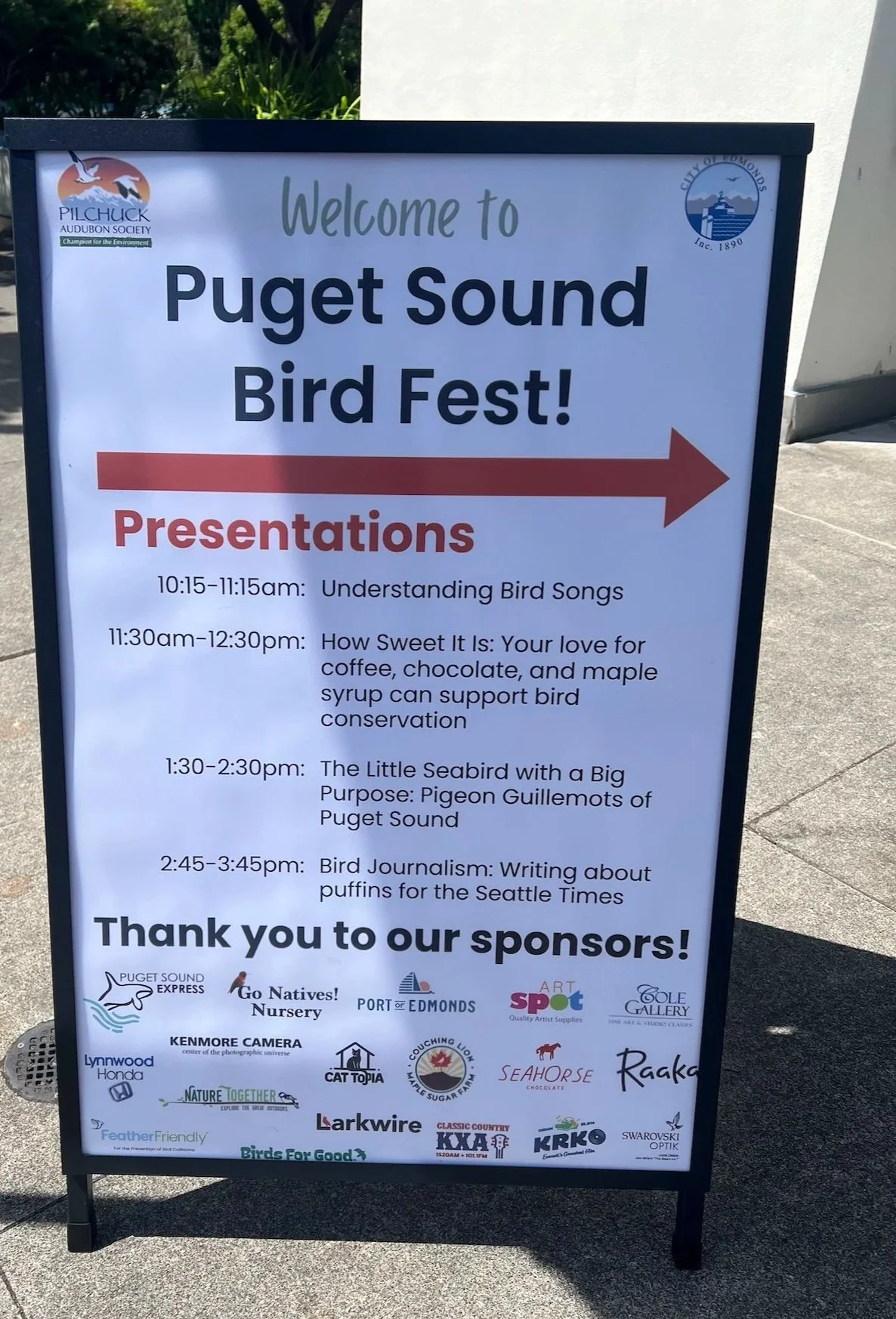
This way to the speakers! I’m the speaker at 11:30. Puget Sound Bird Fest, Edmonds WA, June 2026.
If you can believe it, birding is secondary. My primary focus as a professional are my obligation as a speaker or panelist, and managing the energy it takes in networking and being “on” as a participant.
First, some foundational background: I’ve been writing about birding for a dozen years but only speaking at festivals for three years as of this writing. My speaking opportunities have been both by invitation and from pitching a festival directly. Prior to 2023, I had only ever attended one birding festival, participating as a civilian long before I began writing about the birding scene. That timeline of increased attendance of festivals coincides with these speaking opportunities of the last three years.
With my limited time (I have a day job and I am a parent of two school-age kids), I knew I had to be strategic about attending festivals. I sought the advice of Mollee Brown of Nighthawk Agency who’s a professional guide and consultant to the ecotourism industry. She described the vibe and audience of bird festivals around the US, from Cape May, Biggest Week in Ohio, San Diego, and the Rio Grande Valley birding festivals, among others.
Listening to Mollee’s descriptions, I considered which festivals to pitch to first, based on my catalog of presentations and the described demographic, spirit of the event, and location. A national festival is good for name-building recognition, but not always easy to fit into my schedule. A local festival is easier to fit into my schedule, but surprisingly few have responded to my pitches! Currently, I have had greater success securing speaking gigs with national and international bird festivals, and would jump at the more opportunities to speak in the PNW region of the US. If you are reading this and based in Washington State and interested in a speaker on topics about birding culture, please reach out!
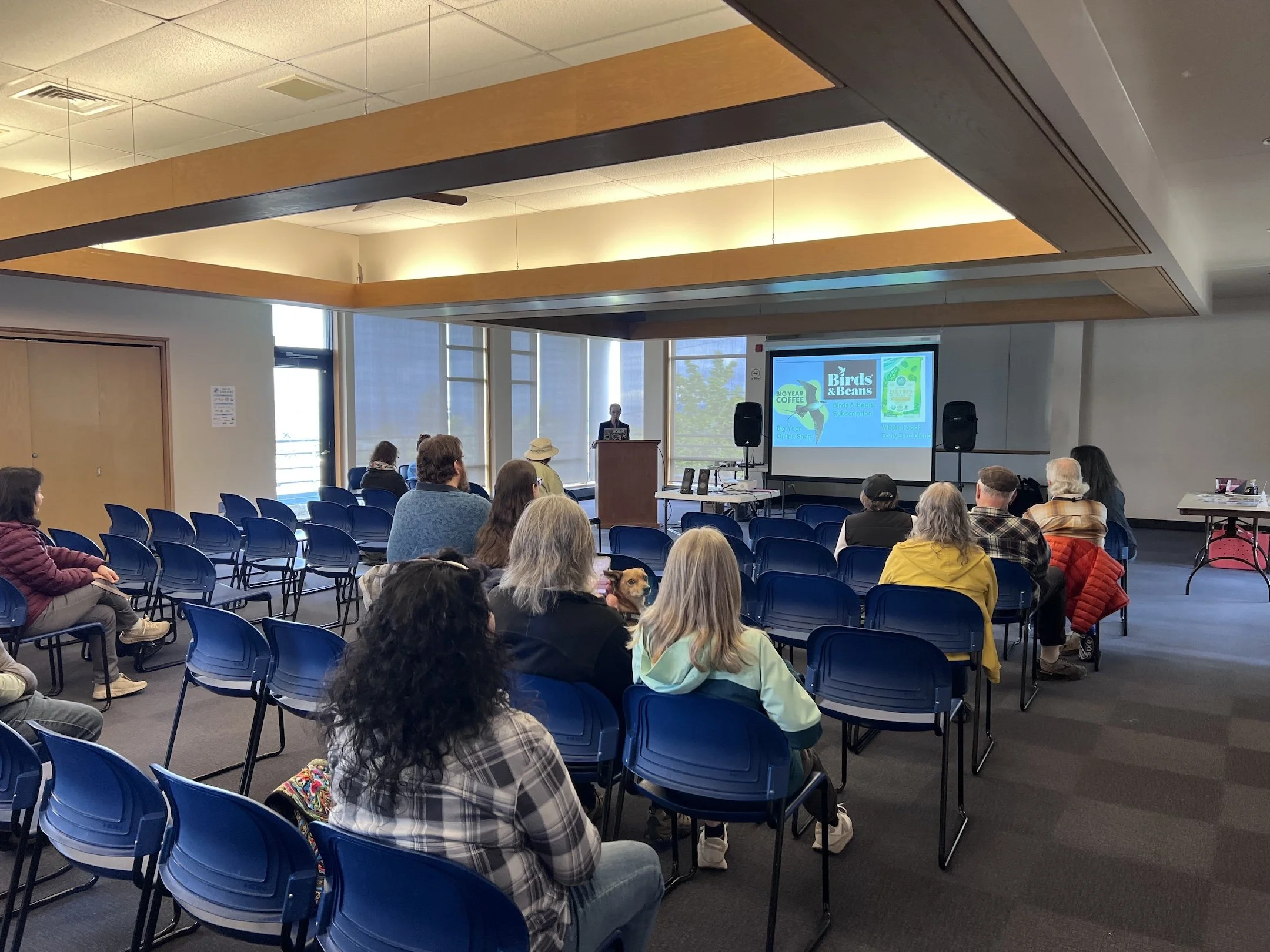
That’s me speaking about Bird Friendly comestibles to an audience at the Puget Sound Bird Fest, Edmonds WA. June 2026. Photo by Emily Pappo.
Happily, I presented at my second-ever local birding festival this June (the first local festival I presented at was the La Conner Birding Festival in my home town, January 2026). I have Brian Zinke, the Executive Director of Pilchuck Audubon to thank for including me and three other speakers at this year’s Puget Sound Bird Fest (PSBF), in Edmonds, Washington, a residential seaside community a few miles north of Seattle.
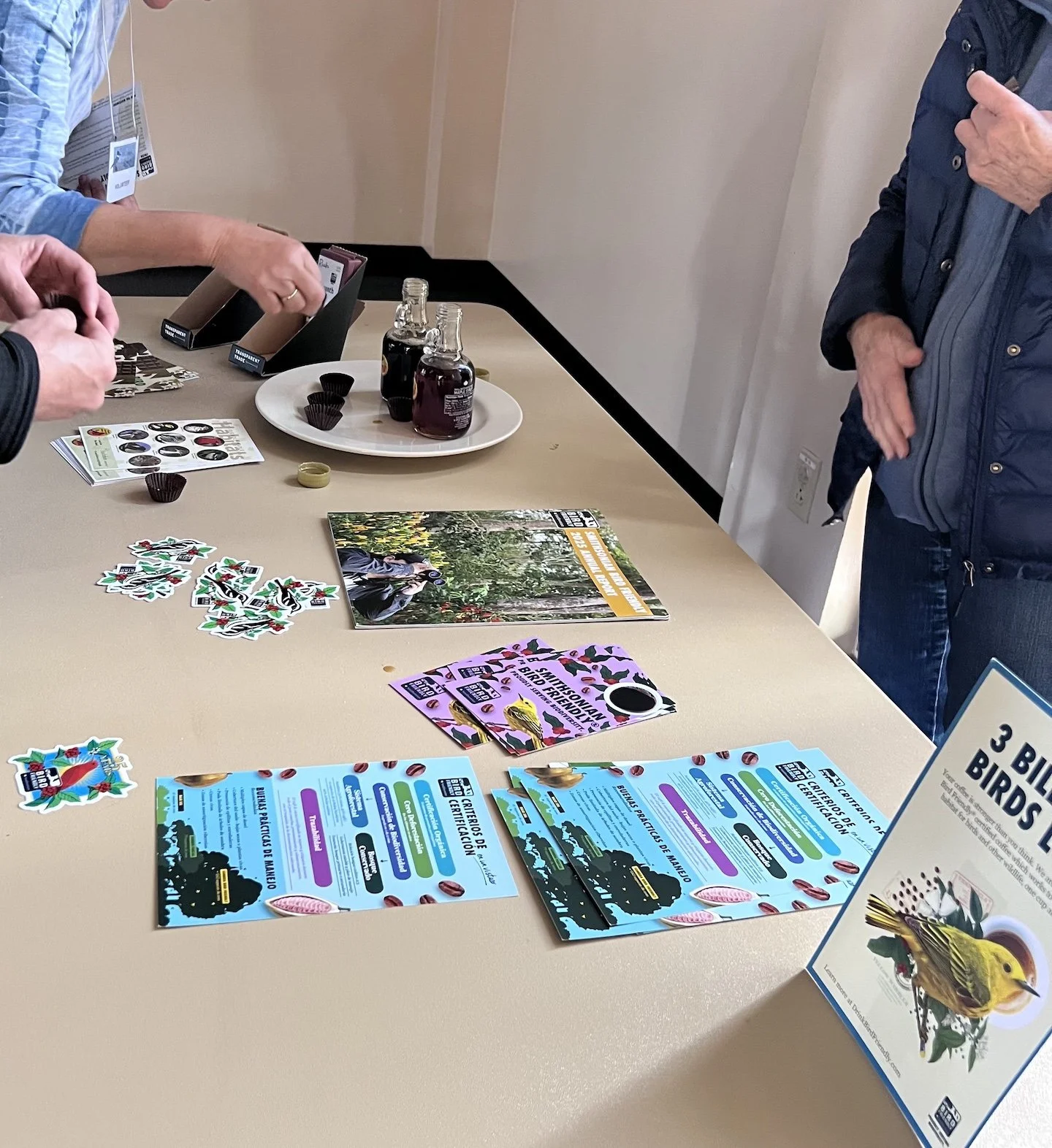
Table I set up with chocolate and maple syrup tasting samples, along with stickers and hand outs about the programs. June 2026. Photo by Emily Pappo.
The festival attracts about 300 people to the Saturday on-site event, and additional people to their Saturday and Sunday guided birding outings all over Snohomish and King Counties. PSBF is the only annual birding festival in the Seattle Metropolitan area, and organized by Pilchuck Audubon.
I spoke about Bird Friendly comestibles coffee, chocolate and maple syrup, and the critical importance of supporting shade-and-native-canopy-rich agroforestry models of growing foods like these three commodities. Supporting such eco-certification and growing programs like Smithsonian Bird Friendly and Audubon Bird Friendly Maple as consumers influences the protections for migratory and resident birds in those human-impacted habitats. Buy bird friendly!
After the talk, I invited audience to partake in samples of chocolate and maple syrup. I love interacting with audience at a speaking gig—I get different questions every time, and audiences are my dynamic beta feedback for improving an existing presentation even more.
Which brings me to my first focus of being the best presenter I can be in the lead up with the organizers, in the moment with the audience, and afterwards as a participant of the event. That means not only the talk itself, but the questions afterwards (and leaving enough mystery in the talk to prompt questions), chatting with audience, volunteers and organizers once the talk is officially over, and concluding in a way that imparts gratitude and interest in participating myself in the rest of the event (I try not to “fly in and out” as a speaker).
To that end, I lingered for the afternoon after my talk and explored the festival “marketplace.” I met Emily Pappo of Seahorse Chocolates, Will Valentine of Will’s Birdbrain Podcast, saw my friend Laurel Mundy of Laurel Mundy Illustration, and met writer Maria Mudd Ruth, author of two great books about local birds of the Pacific Northwest region. Rare Bird (about the Marbled Murrelet) and The Bird with Flaming Red Feet (about the Pigeon Guillemot) are both available in paperback from Bookshop.org (Side note: I will receive a commission if you choose to purchase a book through these links, and I thank you in advance!). Festival “marketplaces” like these are places to discover nature organizations, small companies aligned with conservation, and artists, authors and other media folks for nature. I watched the talk about Tufted Puffins in the Salish Sea by another writer, journalist Amanda Zhou, and by late afternoon was done for the day. I spent the night at my dad and stepmom’s and we were all asleep before dark!
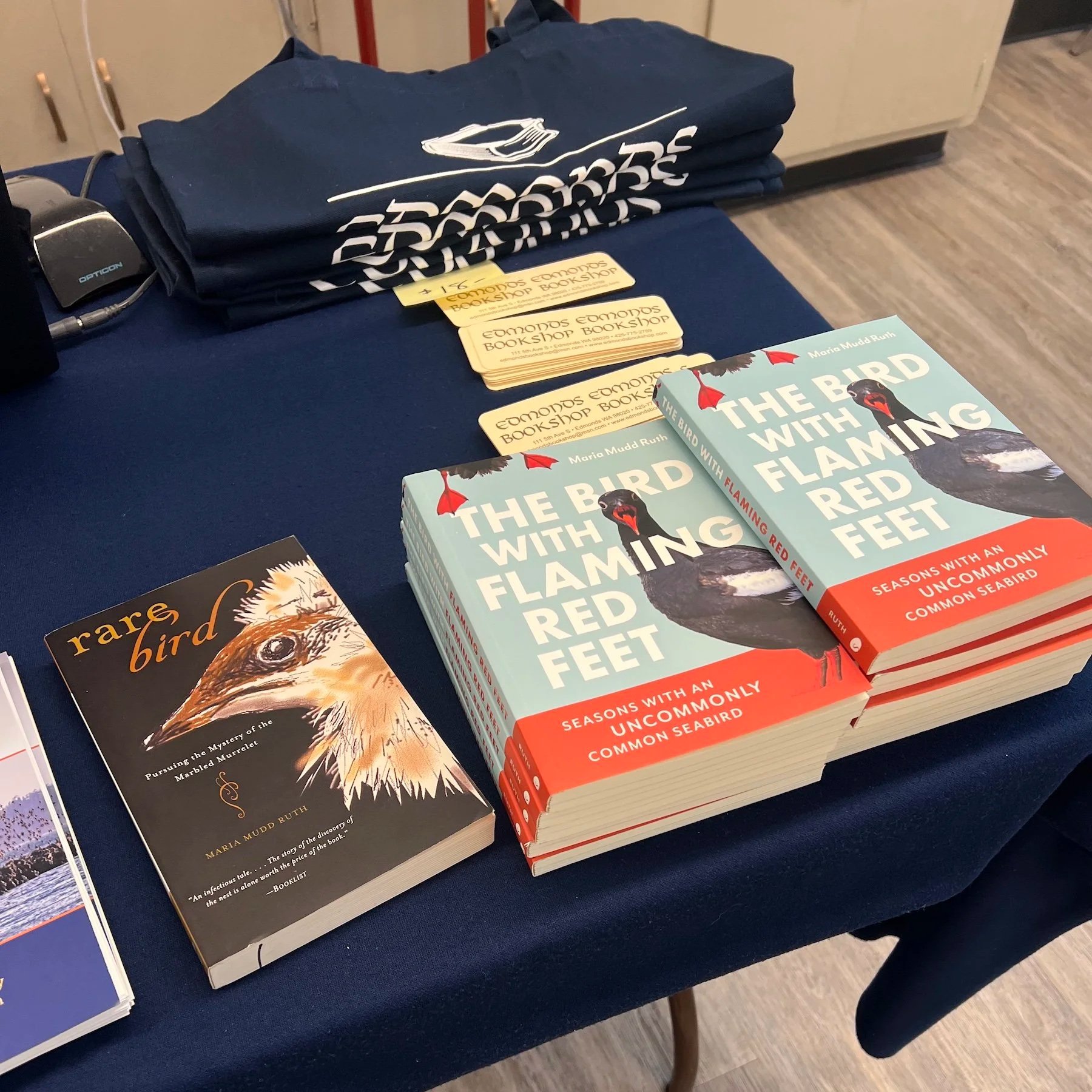
Two books by author Maria Mudd Ruth, who was at the PSBF to accompany Pigeon Guillemot researcher Shannon Boldt presenting on the bird as one of the speakers. Rare Bird and The Bird with Flaming Red Feet are both available as paperbacks from Bookshop.org (I will receive a commission if you choose to purchase a book through these links, and I thank you in advance!). June 2026.
The next day, Sunday, I donned my civilian birder cap and participated in a sold out PSBF bird walk led by dear friend Roniq Bartanen of Shebirds.com. Roniq led a Mindful Birding walk at Union Bay Natural Area near the University of Washington in Seattle for about a dozen birders, starting at 8:30am. Mindful birding is now an established form of birding practice, a departure from competitive birding like listing and big year efforts more often represented as birding in mainstream media.
Mindful birding centers a sensory, moderated form of bird observation. Purposefully slow and without specific goals, and considerate of the entire ecosystem that supports the birds. At least that’s what you can expect on one of Roniq’s mindful birding walks. She is a walking encyclopedia of the plants and habitats that support local birds.
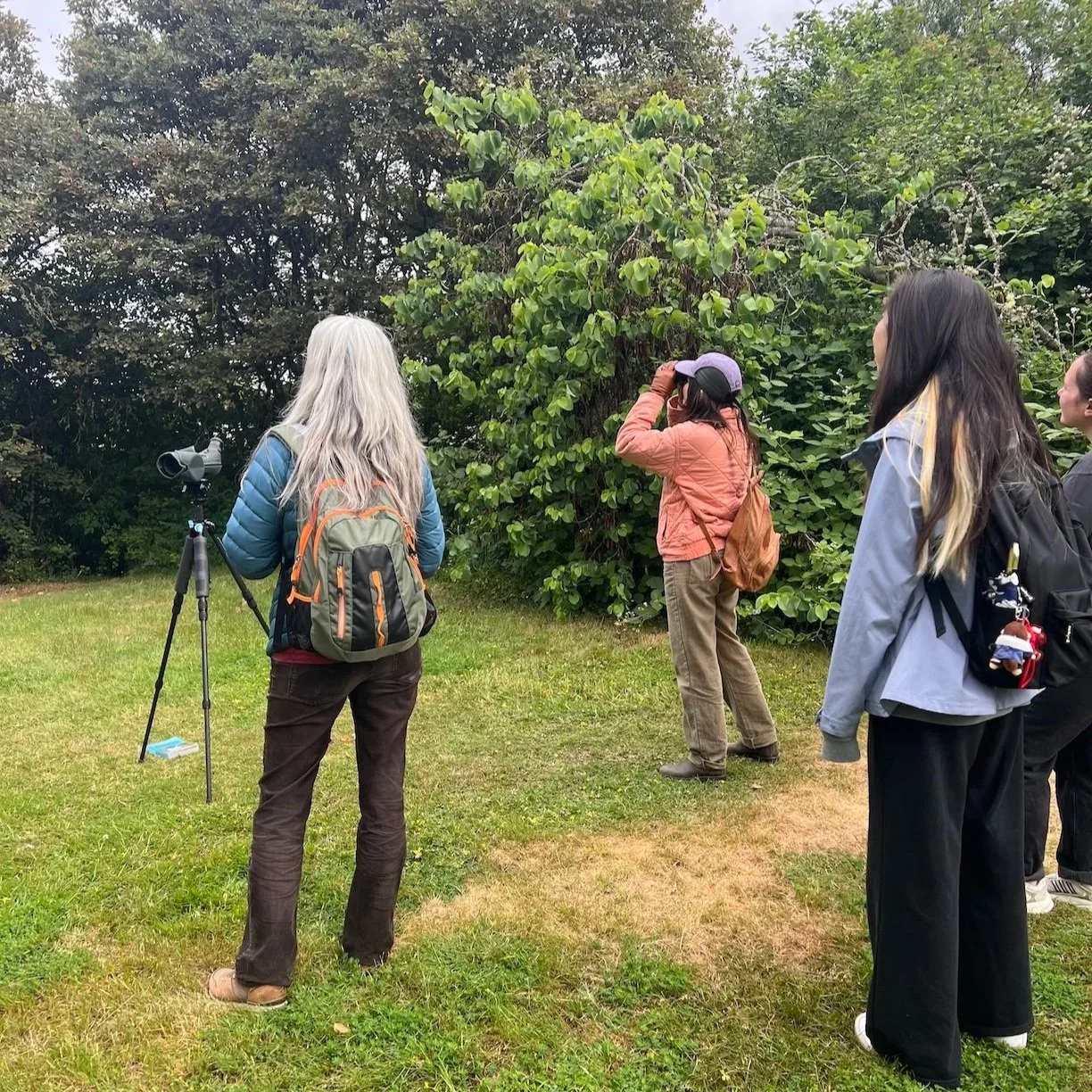
Roniq Bartanen of Shebirds guiding, leading our mindful birding walk at the Union Bay Natural Area in Seattle, part of the Puget Sound Bird Fest list of programming. June 2026.
The group of us—about a dozen female-presenting people ages 20s to 70s (no men on this walk, though Roniq remarked men participate in her mindful birding walks, too)—commenced with a guided meditation led by Roniq. She suggested we listen for sounds in layers of distance from where we sat (we had the option to close our eyes), and concentrate on slowing our breathing. It was a trust building exercise I appreciated for entering the time together as a group.
Afterwards we birded a flat, graveled one-mile loop through reforested parkland on what used to be the city dump. The highlights were close looks at slumbering Bumblebees in native rose (it was a cool enough morning the bees hadn’t begun feeding yet), and watching fledgling Chestnut-backed Chickadees beg from their parents, their vocalizing an oily, high pitched squeaking.
Thus concluded my two-hat participation in the Puget Sound Bird Fest, and I drove home north to Skagit County and promptly took a nap. I’d satisfied civilian and professional ambitions that weekend as a birder, and now it was time to rest.
If you feel inclined, tell me about your favorite bird festival in the comments! Thank you for reading!
While this post and others has an affiliate link to Bookshop.org for book titles I mention, the information I share is free to you, and I share it because I think it’s important for the goals of this website. I am not sponsored by any of the companies I recommend. I make all recommendations because i believe in these products and services for the long game of bird conservation.