
This post was updated on May 18, 2026.
“Best gear” for ten years ago, maybe, but times have changed! Read on to see my updates in italics to the original post. Some things change and one thing stayed the same! Can you guess what stuck around? I’ve also added a Bookshop.org affiliate link to the David Allen Sibley field guide. The other items linked are not affiliated with the respective vendors.
I have a uniform for birding, which doesn't stray far from my everyday uniform. I'm a firm believer in making one's hobby a part of everyday, so long ago adapted Filson bags as part of my sartorial footprint. This one is a small field bag I've had for 21 years (as of this update in 2026) which has served me for work and birding in equal measure. Filson, to their credit, replaced the shoulder strap metal clips on this bag three times over the years for free, and patched the worn spots.
As of this writing update (2026) this small bag is no longer produced by Filson, and they no longer provide repairs like what I describe. Those were the good old days 20 years ago when I accessed those services! Filson is now owned by a private equity firm and has been scrubbed of any visible human touch. Not bitter!
I use Nikon Optics, and 8 x 25 is a fine starting point. This pair of Travelites was a gift from my dad 30 years ago (as of this update in 2026). They're a bit battered like the rest of my gear, but this stuff gets better with age and gives me more street cred! They are super compact, accurate and light, perfect for everyday.
Oh, the innocence of my writer self 10 years ago when I took my vision for granted. Eyes and tools may not get worse as they age but they CHANGE. I now use larger bins and wear glasses because my eyes see differently (my eyesight is worse) and those little bins are useless for me. Use binocular that suit your eyes. Your eyes change over time and your binoculars can too.
You see my preferred bird guide: Sibley. This one is the 2015 edition. While this book is heavier than other guides, it includes updates to his original, which was my mainstay prior. David Sibley puts out regional guides for both Eastern and Western (west of the continental divide) U.S.. I prefer illustrations to photos when in the field. Sibley guides are entirely illustrated (meaning no photos) and include maturity, flight and repose angles and breeding plumage of each bird, as well as regional variations of morphology, and range maps.
Ten years on, I now use the Sibley app on my phone and no longer carry a field guide. I recommend Sibley’s app for the same reasons as his book—illustrations from various angles, range, basic natural history—and the app also includes comparison screens for similar species, and birdsong from the Cornell Lab of Ornithology. Some birders prefer Cornell’s free field guide app Merlin. I’ve had the Sibley app since before Merlin was around, and now use both. I jump back and forth between them.
Finally, my hat. I'm a hat person if you have caught on, and this one is a vintage fedora from a company since gone out of business but you can find a similar fedora here. I have hats for winter and summer in different materials. Hats are great because they keep the sun out of your eyes for easy access to your bins (not taking your sunglasses on and off constantly), and in cold weather, they keep your head warm.
The hat is still in the picture! Here I am wearing it in May, 2025, on the Lewes Cape May Ferry across Delaware Bay. This hat is now going on 25 years of wear.
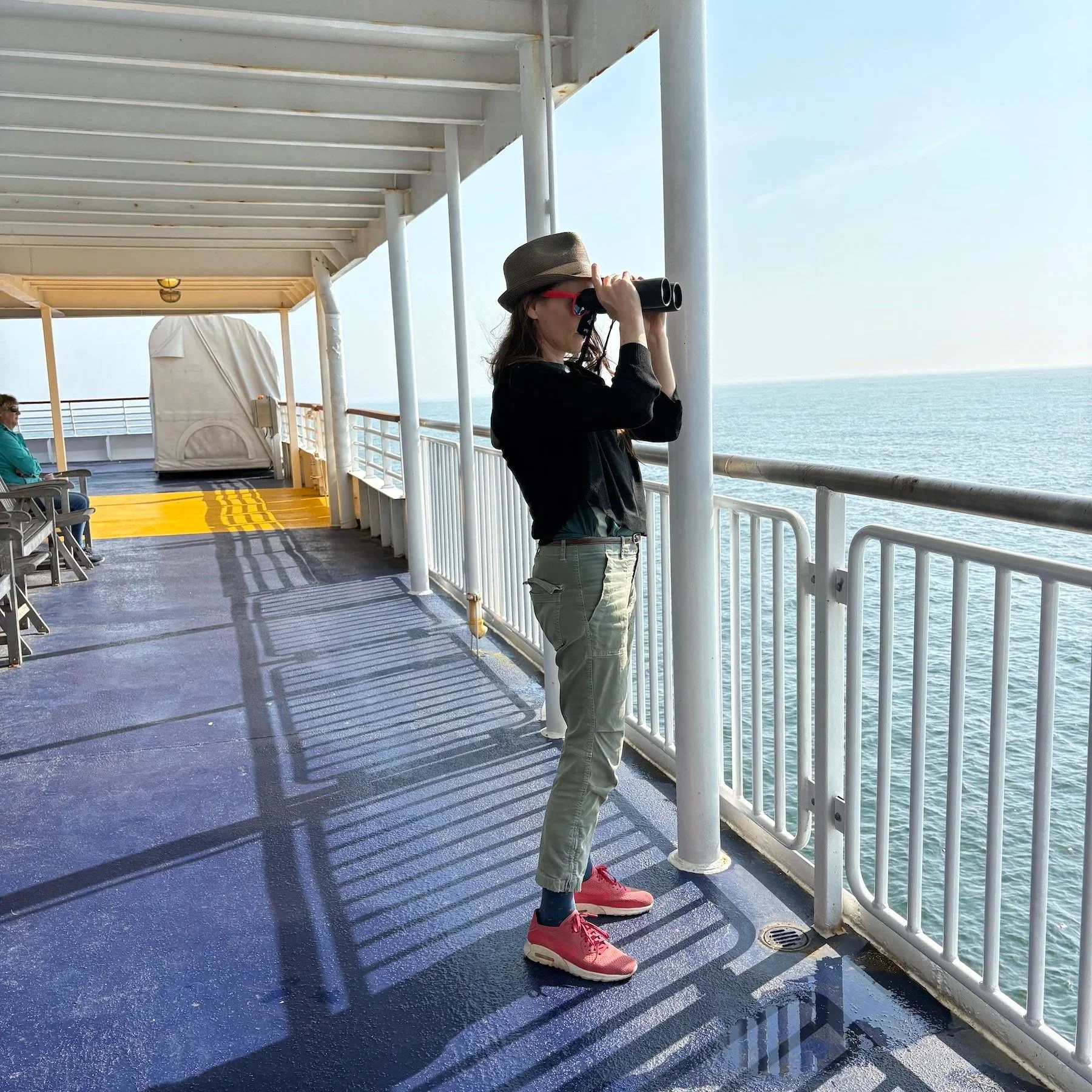
I was looking at porpoises or gulls on this crossing. Lewes Cape May Ferry, Delaware Bay between Delaware and New Jersey, May 2025. Photo by Orietta Estrada.
The lesson here is “best gear” is relative to you as the birder, and feel free to adapt as you age, as you can afford to upgrade or not, and as you decide what kind of birder you want to be. I no longer carry a bag when I bird, for the most part—the phone in my pocket and the binoculars around my neck are my uniform now.
How has your gear changed over the years? Share in the comments!